Penetration seals
Every pipe, cable and conduit through a fire wall or floor gets a seal matched to it.
- Every seal labelled and photographed
- BM TRADA / FIRAS-certificated contractors
- Written price before any work
A penetration seal closes the gap where a service passes through a fire wall or floor. Three things decide which seal is used. What the service is. What the wall or floor is made of. How big the gap is.
Get one of them wrong and the seal is outside its test, even if it looks neat.
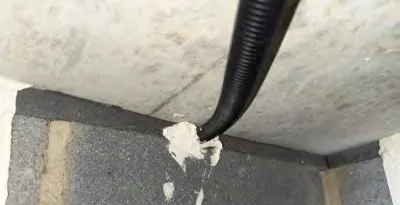
Read the photo
The photo on this page is from a school block we worked on. A black corrugated conduit goes into a wall just under the concrete soffit. Round it is a lump of white foam.
What is wrong with it?
The foam is unidentified. Builders' expanding foam is common in this spot and is not a fire seal on its own.
The conduit is plastic. In a fire it softens, and the hole opens up.
There is no tag and no record.
What it needs: foam cut out, the conduit given a seal tested for plastic conduit in that wall, often a wrap or a mastic detail, and a tag.
Common services and their seals
Soil and waste pipes: collars under floors, collars or wraps in walls.
Copper and steel pipes: mastic, sometimes with a sleeve.
Cables: mastic for a few, batt and mastic for trays and bundles.
Conduit: depends on plastic or steel, and whether it carries cables. Many tests treat these differently.
Gas pipes: mastic or a sleeve detail. The gas pipe itself is never cut or moved by us.
Floors and walls are different
A seal tested in a 150mm concrete floor is not automatically tested in a 100mm plasterboard wall. Floors also need the collar on the right face, usually the underside.
Record
Each seal gets a number. The record lists the service, its size, the wall or floor, the product, the rating and the photos.
Our BM TRADA / FIRAS-certificated contractors carry out the work.
Give us the postcode, the use of the building and the number of floors. A survey page or a few photos of the gaps lets us price it faster.